[PART 01] Diploma in electronics and telecommunication engineering (ETC) interview question (Upcoming) 2023
- Types of Electronic component
What is Electronic?
OrThrough the study of electronics, we can control the flow, behavior, and movement of the electrons and other electrically charged particles in the semiconductor, conductor, vacuum, or gas. Electronics is a branch of physics and technology that deals with electronic devices that are made by an electronic circuit called components like transistors, capacitors, diodes, and chips.
(i) What is an Electron?
An electron is a negatively charged particle that can be either bound to an atom or free (not bound). An electron that is bound to an atom is one of the three primary types of particles within the atom -- the other two are protons and neutrons.
(ii) Particles?
A very small piece; a bit.
3. What is a passband?
Passband is a variety of frequencies or wavelengths that can pass through a filter without attenuation. The passband signals are usually of high frequency and use modulation to transmit through long distances while having their frequency spectrum concentrated around the carrier wave's frequency."- For example, a radio receiver contains a bandpass filter to select the frequency of the desired radio signal out of all the radio waves picked up by its antenna.
4. What is an ideal current source OR consent current source?- A current source will provide a constant current output with maximum efficiency at any given point, even if the load resistance changes.
5. What is an ideal voltage source or the Constant Voltage Source?
an ideal voltage source produces a fixed voltage output that does not vary with changes in the current flowing through the circuit.
Batteries are an example of an ideal voltage source.
6. What is feedback?Ans: Feedback is a process whereby some proportion of the output signal of a system is passed (fed back) to the input. This is often used to control the dynamic behavior of the system.
Negative feedback and positive feedback? With example.
Positive Feedback is the type of feedback in which the feedback signal and the reference input signal are added at the input side of the system to produce the error signal is called positive feedback.
The type of feedback in which the feedback signal and the reference input signal are subtracted at the input side of the system to produce the error signal is known as negative feedback.
Example for negative feedback and positive feedback?
Ans: An example of -ve feedback is Amplifiers And +ve feedback is Oscillators.
7. What is a resistor?A resistor is A passive electrical component with two terminals that are used for either limiting or regulating the flow of electric current and lowering the voltage in any particular portion of the circuit. It is made of copper wires and the outer part of the resistor is coated with insulating paint.
These small devices ensure components like transistors or integrated circuits do not destroy due to a sudden increase in the current that reaches them.SI Unit of Resistor?
The SI unit of the resistor is Ohm.
8. Different types of communication?Analog and digital communication.
As a technology, analog is the process of taking an audio or video signal (the human voice) and translating it into electronic pulses. Digital on the other hand is breaking the signal into a binary format where the audio or video data is represented by a series of "1"s and "0"s.
Digital signals are immune to noise, quality of transmission and reception is good, components used in digital communication can be produced with high precision and power consumption is also very less when compared with analog signals.9. Does the Norton theorem apply to linear circuitry?
Yes, Norton's theorem applies to linear circuitry. It helps measure the equivalency of batteries and resistors in the circuit. This further helps determine the amplitude of distortion within the electrical signals. This theorem is useful when we are designing sound systems and stereo equipment.
10. What is op-amp?Ans: An operational amplifier, often called an op-amp, is a DC-coupled high-gain electronic voltage amplifier with differential inputs and, usually, a single output. Typically, the output of the op-amp is controlled either by negative feedback, which largely determines the magnitude of its output voltage gain or by positive feedback, which facilitates regenerative gain and oscillation.
11. How is Ohm's law used to calculate the current of an electrical device?
I first determine the voltage and resistance of the electrical device. Once I understand these values, I divide the voltage by resistance to calculate the current inside the device.
12. What is IC? Where and why use it?An integrated circuit (IC), sometimes called a chip, microchip, or microelectronic circuit is a semiconductor wafer on which thousands or millions of tiny resistors, capacitors, diodes, and transistors are fabricated. An IC can function as an amplifier, oscillator, timer, counter, logic gate, computer memory, microcontroller, or microprocessor.
Uses - keyboards, Headphones, speakers, microphones, Smartphones, tablets, smartwatches, Smart speakers, Digital photos, video cameras, Video game consoles and controllers, and vehicles.

13. When designing an electric switch, which diode are you likely to use and why?
When designing an electric switch, I would use a silicon diode over a germanium diode. This is primarily because a silicon diode has lower conductivity and higher heat resistance. This makes it an ideal choice in designing electrical applications.
14. What is a semiconductor?Semiconductors are materials that have a conductivity between conductors (generally metals) and nonconductors or insulators (such as most ceramics). Semiconductors can be pure elements, such as silicon or germanium, or compounds such as gallium arsenide or cadmium selenide. In a process called doping, small amounts of impurities are added to pure semiconductors causing large changes in the conductivity of the material.These get further classified into n-type and p-type semiconductors.
15. What is modulation?Two signals are involved in the process of modulation. baseband signals are the band of frequencies representing the original signal. This is the signal to be transmitted to the receiver. The frequency of such a signal is usually low. The other signal involved with this is a high-frequency sinusoidal wave. This signal is called the carrier signal. The frequency of carrier signals is almost always higher than that of the baseband signal. Such a higher-frequency carrier is able to travel much farther than the baseband signal. Therefore, modulation can be defined as the process of superimposing a low-frequency signal on a high-frequency carrier signal.
There are three types of Modulation:
- Amplitude Modulation
- Frequency Modulation
- Phase Modulation
It's very common practice in communication."
16. What is the heating principle used in a microwave oven?
The microwave oven uses an electron tube called a magnetron which helps produce the microwaves. These electromagnetic waves reflect within the interiors and get absorbed by the food. This causes the water particles in them to vibrate; thus, heating the food.
- 17. What is demodulation?
Demodulation is the process of extracting the original information-bearing signal from a carrier wave. A demodulator is an electronic circuit (or computer program in a software-defined radio) that is used to recover information from the modulated carrier wave. There are many types of modulation so there are many types of demodulators. The signal output from a demodulator may represent sound (an analog audio signal), images (an analog video signal), or binary data (a digital signal).
18. How does a capacitor work?
Unlike the battery, a capacitor is a circuit component that temporarily stores electrical energy by distributing charged particles on (generally two) plates to create a potential difference. A capacitor can take a shorter time than a battery to charge up and it can release all the energy very quickly.First, we can note that a metal typically has an equal amount of positively and negatively charged particles, which means it’s electrically neutral.
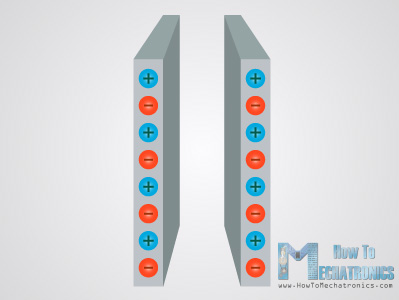
If we connect a power source or a battery to the metal plates of the capacitor, a current will try to flow, or the electrons from the plate connected to the positive lead of the battery will start moving to the plate connected to the negative lead of the battery. However, because of the dielectric between the plates, the electrons won’t be able to pass through the capacitor, so they will start accumulating on the plate.
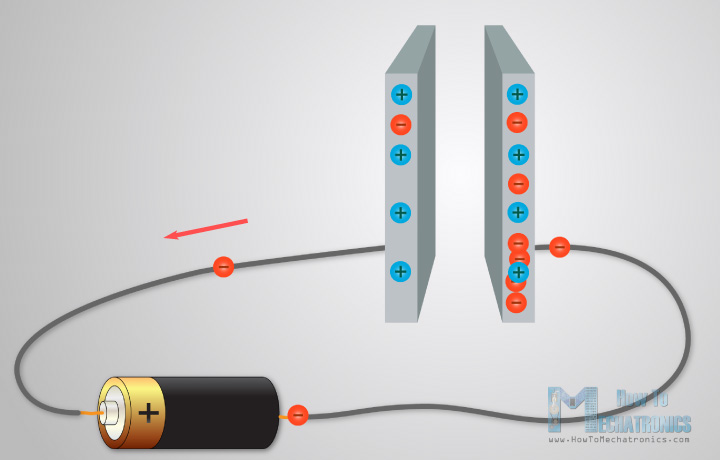
After a certain number of electronics accumulated on the plate, the battery will have insufficient energy to push any new electronics to enter the plate because of the repulsion of those electronics which are already there.
At this point, the capacitor is actually fully charged. The first plate has developed a net negative charge, and the second plate has developed an equal net positive charge, creating an electric field with an attractive force between them that holds the charge of the capacitor.
19. What is a bipolar junction transistor?
What is a Bipolar Junction Transistor (BJT)?
A bipolar junction transistor is a three-terminal semiconductor device that consists of two p-n junctions which are able to amplify or magnify a signal. It is a current controlled device. The three terminals of the BJT are the base, the collector, and the emitter. A signal of a small amplitude applied to the base is available in the amplified form at the collector of the transistor. This is the amplification provided by the BJT. Note that it does require an external source of DC power supply to carry out the amplification process.
Bipolar Junction Transistor Symbol

Construction of Bipolar Junction Transistor
BJT is a semiconductor device that is constructed with 3 doped semiconductor Regions i.e. Base, Collector & Emitter separated by 2 p-n Junctions.
Bipolar transistors are manufactured in two types, PNP and NPN, and are available as separate components, usually in large quantities. The prime use or function of this type of transistor is to amplify current. This makes them useful as switches or amplifiers. They have a wide application in electronic devices like mobile phones, televisions, radio transmitters, and industrial control.
Operation of Bipolar Junction Transistor
There are three operating regions of a bipolar junction transistor:
- Active region: The region in which the transistors operate as an amplifier.
- Saturation region: The region in which the transistor is fully on and operates as a switch such that collector current is equal to the saturation current.
- Cut-off region: The region in which the transistor is fully off and collector current is equal to zero.
Types of Bipolar Junction Transistor
There are two types of bipolar junction transistors:
- PNP bipolar junction transistor
- NPN bipolar junction transistor
PNP BJT
In PNP BJT, the n-type semiconductor is sandwiched between the two p-type semiconductors. The two p-type semiconductors act as emitter and collector respectively while the n-type semiconductor acts as a base. This is shown in the figure below.

The current enters the transistor through the emitter such that the emitter-base junction is forward biased and the collector-base junction is reverse biased.
NPN BJT
In NPN BJT, p-type semiconductor is sandwiched between the two n-type semiconductors. The two n-type semiconductors act as emitter and collector respectively while the p-type semiconductor acts as a base. This is shown in the figure below.
Current entering the emitter, base, and collector has the sign convention of positive while the current that leaves the transistor has the sign convention of negative.Function of Bipolar Junction Transistor
BJTs are of two types namely NPN and PNP based on doping types of the three main terminals. An NPN transistor consists of two semiconductor junctions that have a thin p-doped anode region and PNP transistor also consists of two semiconductor junctions that have a thin n- doped cathode region.

The flow of charge in a Bipolar transistor is due to the diffusion of charge carriers between the two regions belonging to different charge concentrations. Regions of BJT are known as the base, collector, and emitter.
The emitter region is highly doped when compared to other layers. Both collector and base layers have the same charge carrier concentrations. Among these junctions, the base-emitter junction is forward biased, and the base-collector junction is reverse biased. Forward biased means p-doped region has more potential than the n-doped side.
Suggested Reading
Voltage, Charge Control and Current
The base-emitter current is controlled by the collector-emitter current. This conclusion is drawn by the current-voltage relation of the base-emitter junction. Collector current has a base region where minority carriers are concentrated.
Transistor models such as the Glenn poon model are responsible for the distribution of the charge which explains the behaviour of a transistor.Configuration of Bipolar Junction Transistors
Since a Bipolar Junction Transistor is a three-terminal device, there are three ways to connect it within an electric circuit while one terminal is the same for both output and input. Every method of connection responds differently to the input signals within a circuit.
- Common Emitter Configuration – has both voltage and current gain
- The common Collector Configuration – has no voltage gain but has a current gain
- The common base configuration – has no current gain but has a voltage gain
Characteristics of different transistor configurations are given in the following table:
Characteristics Common Base Common Emitter Common Collector Power Gain low Very high medium Current gain low medium high Voltage gain High Medium low Phase angle 0 180 0 Output impedance Very high high low Input Impedance Low medium high Applications of BJT
We know that a bipolar junction transistor is used as a switch, as an amplifier, as a filter, and even as an oscillator. Below is the list of other applications of bipolar junction transistor:
- BJT is used as a detector or also known as a demodulator.
- BJT finds application in clipping circuits so that the waves can be shaped.
- Logic circuits and switching circuits use BJT.
Frequently Asked Questions – FAQs
Q1Who invented BJT?
BJT was invented by W.H Brattin, Bardeen, and William Shockley.
Q2What are the operating regions of BJT?
The operating regions of BJT are:
- Forward active or active region
- Reverse active or inverted region
- Saturation
- Cut-off
Q3What are the applications of BJT?
Following are the applications of Bipolar Junction Transistor:
- It is used as an amplifier
- It is used as an oscillator
- It is used as a demodulator
Q4What happens if the transistor is not biased properly?
Following is the list of consequences if the transistor is not biased properly:
- The work efficiency of the transistor reduces
- There will be a distortion in the output signal
- The operating point may shift
- Transistor parameters will change
Q5Why is there a maximum limit for the collector supply voltage for a transistor?
There is a maximum limit for the collector supply voltage for a transistor because when the collector current is increased rapidly there are chances of transistor getting damaged. To avoid this, the voltage in the collector should have a maximum limit.
20. Can you explain the principle of Bluetooth?
Ans: Wireless Personal Area Network (WPAN) technology is used for exchanging data over smaller distances. (10m). It is Omni directional i.e. it does not have a line-of-sight limitation like infra-red does. It employs UHF radio waves in the ISM bands, from 2.402 GHz to 2.48 GHz.It is mainly used as an alternative to wire connections. It offers transfer speeds of around 720 Kbps.
21. What is sampling?In signal processing, sampling is the reduction of a continuous-time signal to a discrete-time signal. A common example is the conversion of a sound wave to a sequence of "samples". A sample is a value of the signal at a point in time and/or space; this definition differs from the usage in statistics, which refers to a set of such values.
A sampler is a subsystem or operation that extracts samples from a continuous signal. A theoretical ideal sampler produces samples equivalent to the instantaneous value of the continuous signal at the desired points.
The original signal can be reconstructed from a sequence of samples, up to the Nyquist limit, bypassing the sequence of samples through a type of low-pass filter called a reconstruction filter.
22. What is Sampling Theorem?
It states that, while taking the samples of a continuous signal, it has to be taken care that the sampling rate is equal to or greater than twice the cut-off frequency, and the minimum sampling rate is known as the Nyquist rate.
23. What is the cut-off frequency?
24 What Is a stopband?
25. Explain RF
26. Name of The modulation techniques.
27. Explain the AM & FM.
28. Where do we use AM and FM?Ans: AM is used for video signals for example TV. Ranges from 535 to 1705 kHz.
FM is used for audio signals, for example, Radio. Ranges from 88 to 108 MHz.
29. What is a base station?Ans: A base station is a radio receiver/transmitter that serves as the hub of the local wireless network, and may also be the gateway between a wired network and the wireless network.
30. What is a Diode?A diode is an electronics component made from a combination of a P-type and N-type semiconductor material (silicon and germanium), known as a p-n junction.
The lead attached to the n-type semiconductor is called the cathode it is the negative side of the diode. The positive side of the diode — that is, the lead attached to the p-type semiconductor — is called the anode.
In simple words: A diode is a two-terminal electronic component that conducts current primarily in one direction (asymmetric conductance). It has low (Ideally zero) resistance in one direction, and high (Ideally infinite) resistance in the other.

Types of Diodes
- Light Emitting Diode
- Laser diode
- Avalanche diode
- Zener diode
- Schottky diode
- Photodiode
- PN junction diode
Characteristics of Diode
The following are the characteristics of the diode:
- Forward-biased diode
- Reverse-biased diode
- Zero biased diode
Diode Applications
Following are the applications and uses of the diode:
- Diodes as a rectifier
- Diodes in the clipping circuit
- Diodes in clamping circuits
- Diodes in logical gates
- Diodes in reverse current protection
Frequently Asked Questions – FAQs
Can a diode be used as a rectifier?
Yes, diodes can be used as a rectifier.
Define a diode?
A diode is a two-terminal device that has the capacity to conduct electricity in only one direction.
Which type of semiconductors is used in manufacturing diodes?
Semiconductor materials like silicon and germanium are commonly used in diodes.
Name the diode which has the ability to produce coherent light?
LED diodes can produce coherent light.
Which is the diode used in solar cells and photometers?
A photodiode is used in solar cells and a photometer
- Diodes as a rectifier
- Forward-biased diode
31. What is a repeater?
A repeater is a network device that retransmits a received signal with more power. A repeater is implemented in computer networks to expand the coverage area of the network and repropagate a weak or broken signal and or remote service nodes. Repeaters amplify the received/input signal to a higher frequency domain so that it is reusable, scalable, and available.
Repeaters are also known as signal boosters.
32. What is an amplifier?An amplifier, electronic amplifier, or (informally) amp is an electronic device that can increase the power of a signal (a time-varying voltage or current). It is a two-port electronic circuit that uses electric power from a power supply to increase the amplitude (magnitude of the voltage or current) of a signal applied to its input terminals, producing a proportionally greater amplitude signal at its output. The amount of amplification provided by an amplifier is measured by its gain: the ratio of output voltage, current, or power to input. An amplifier is a circuit that has a power gain greater than one.

33.What is negetive feedback and positive feedback?
34. what is an oscillator?An oscillator is a mechanical or electronic device it is works on the principles of oscillation that produces a periodic, oscillating electronic signal, often a sine wave or a square wave, or a triangle wave. Oscillators convert DC signal to periodic AC signals which can be used to set frequency, be used for audio applications, or used as a clock signal.Computers, clocks, watches, radios, and metal detectors are among the many devices that use oscillators.
- Types of oscillators?
There are two types of oscillator circuits available they are linear and nonlinear oscillators.
35. What is crosstalk in communication?Crosstalk is a disturbance caused by the electric or magnetic fields of one telecommunication signal affecting a signal in an adjacent circuit. Essentially, every electrical signal has a varying electromagnetic field.
The most common example is hearing an unwanted conversation on the telephone. Crosstalk can also occur in radios, televisions, networking equipment, and even electric guitars.
36. What is an inductor?Ans: An inductor(coils or chokes) is a passive component that is used in most power electronic circuits to store energy in the form of magnetic energy when electricity is applied to it. Inductors slow down current surges or spikes by temporarily storing energy in an electromagnetic field and then releasing it back into the circuit.
The S.I. unit of inductance is henry (H) and when we measure magnetic circuits it is equivalent to weber/ampere. It is denoted by the symbol L.


37. What is Capacitor?
38. What is a Rectifier?
39. What is Multiplexing?
40. What are the three main divisions of the power system?
Ans- The three main divisions of the power system include the transmission system, generating system, and distribution system.
41. What is an Instrumentation Amplifier (IA) and what are all the advantages?
Ans: An instrumentation amplifier is one kind of IC (integrated circuit). An Instrumentation Amplifier (In-Amp) is used for low-frequency signals (≪1 MHz) to provide a large amount of Gain. It amplifies the input signal rejecting Common-Mode Noise that is present in the input signal. Instrumentation Amplifier provides the most important function of Common-Mode Rejection (CMR).
- Common-mode rejection is very high.
- Input impedance is very high to avoid loading down the input signal source and Output impedance is very low.
- The offset voltage is minimized.
- voltage Gain is high as the configuration uses high-precision resistors.
42. What do you understand about the impedance diagram?
43. What is the requirement for the load flow study?
44. What is the requirement for base values?
45. Define Power Rating?
A power rating is a measurement of the maximum amount of power that can be used with a specific tool or device. It is provided in order to keep the user safe and to prevent the tool or device from becoming damaged.
46. What is a rheostat?
rheostat, an adjustable resistor used in applications that require the adjustment of current or the varying resistance in an electric circuit. The rheostat can adjust generator characteristics, dim lights, and start or control the speed of motors.


47. What do you mean by demodulation?
Ans- Demodulation is the act of modulation removal from an analog signal to receive the original baseband signal back.
48. What are GPRS services?
Ans: General Packet Radio Service (GPRS) is a packet-based mobile data service on the global system for mobile communications (GSM) of 3G and 2G cellular communication systems. It is a non-voice, high-speed and useful packet-switching technology intended for GSM networks.
49. What is a Photodiode?
Ans- A photodiode is made specifically to detect light quickly in a solar cell for the collection of energy from light. They are both silicon diodes but modified to meet their various requirements.
50. What is a solar cell?
Ans- A solar cell, also known as a photovoltaic cell, is a type of electrical device that converts the energy of light directly into electricity through the photovoltaic effect, which is a chemical and physical phenomenon.
16. How do you make a memory card for a mobile phone?
Ans- A memory chip stores bits and is mounted on a card with electrical contacts so that the computer or camera can send the data that needs to be stored.
17. What is handover?
Ans- Handover in mobile communication mainly refers to the process of call transfer from one network cell to another without disrupting the call.
18. What is CDMA?
Ans- CDMA, also known as the Code Division Multiple Access, is mainly known for utilizing the digital format.
19. Explain the concept of frequency reuse?
Ans- Frequency reuse is a technique for utilizing a specified range of frequencies more than once in the radio system so that the system’s total capacity is increased without increasing the allocated bandwidth.
20. Explain Bluetooth?
Ans- Bluetooth is mainly designed to be a personal area network, where the participating entities are mobile, which requires sporadic communication with others. It is Omnidirectional, i.e., it does not have a line of sight limitation like the infrared does.
21. What are the functions of the base station system (BSS)?
Ans- The functions of BSS are as follows:
● BTS and TC control.
● Radio path control.
● Connection establishment with MS-NSS.22. What is an analog-to-digital conversion of signals?
Ans- Analog-to-digital conversion of signals is defined by the specification of its value only at discrete times, known as sampling instants.
23. What is the main difference between latches and flip flops?
Ans- Flip flops have clock signals, while latches don’t need any kind of clock pulse.
24. What is the difference between voltage and potential?
Ans- A Voltage is referred to as the potential difference between the two points, whereas potential means its force.
25. What is the effect of threshold value on transmission power increased or decreased in telecommunication?
Ans- When the transmission power increases the sensitivity of the antenna, the threshold increases or decreases.
Electronics work on DC and with a voltage range of -48vDC to +48vDC. If the electronic device is plugged into a standard wall outlet, there will be a transformer inside which will convert the AC voltage you are supplying to the required DC voltage needed by the device. Examples: Computer, radio, T.V, etc...
Electric devices use line voltage (120vAC, 240vAC, etc...). Electric devices can also be designed to operate on DC sources but will be at DC voltages above 48v. Examples: are incandescent lights, heaters, fridges, stoves, etc.Basis For Comparison
Electrical Device
Electronics Device
Definition
It is defined as a device that uses electrical energy for performing the work.
The device which controls the flow of electrons for performing the task is known as the electronics device.
Material Used
Metals like copper and aluminium are used for the conduction of current.
Semiconductor materials like silicon, germanium, etc.
Operating Principle
Convert electrical energy into other forms of energy.
Uses electrical energy for performing the task.
Current
Alternating Current
Direct Current
Voltage
Works on high voltage.
Works on low voltage
Power consumption
More
Less
Manipulation
Do not manipulate the data
It manipulates the data.
Response Time
Fast
Slow
Required Space
More
Less
Safe
Less
More
Uses
For doing mechanical work.
For amplifying the weak signal or for coding and decoding the information.
Examples
Transformer, motor, generator etc.
Transistor, diode, microprocessor, flip-flop, amplifier, etc.
(i)What is Direct current (DC)?
Direct current (DC) is an electric current that is uni-directional, so the flow of charge is always in the same direction or one-directional.
An electrochemical cell is a prime example of DC power. Direct current may flow through a conductor such as a wire, but can also flow through semiconductors, insulators, or even through a vacuum as in electron or ion beams. The electric current flows in a constant direction, distinguishing it from alternating current (AC). A term formerly used for this type of current was galvanic current.(ii) What is Alternating current (AC)?
An alternating current can be defined as a current that changes its magnitude and polarity at regular intervals of time. It can also be defined as an electrical current that repeatedly changes or reverses its direction opposite to that of a Direct Current or DC which always flows in a single direction as shown below. From the graph, we can see that the charged particles in AC tend to start moving from zero. It increases to a maximum and then decreases back to zero completing one positive cycle. The particles then reverse their direction and reach the maximum in the opposite direction after which AC again returns to the original value completing a negative cycle. The same cycle is repeated again and again.
(iii) What is Line voltage?
Line voltage is somewhat of an autological phrase in that the words define themselves. The voltage delivered to a destination (e.g., a house, hotel, or restaurant) via the power line is called line voltage. Today, the most powerful line voltage in the United States is 110 to 120 volts.

3. What Is communication?
Communication means transferring a signal from the transmitter which passes through a medium then the output is obtained at the receiver. (or)communication says as transferring of message from one place to another place called communication.
(i) What is the transmitter, Receiver and amplifier?
A transmitter is an electronic device used in telecommunications to produce radio waves in order to transmit or send data with the aid of an antenna. The transmitter is able to generate a radio frequency alternating current that is then applied to the antenna, which, in turn, radiates this as radio waves. There are many types of transmitters depending on the standard being used and the type of device; for example, many modern devices that have communication capabilities have transmitters such as Wi-Fi, Bluetooth, NFC and cellular.
Transmitter and receiver are electronic devices which are used to transmit and receive
useful data and information in the air.
Production of radio waves with the help of the antenna provided generates radio frequency on
application of current which excites the alternating current and thus produces radio waves and further radiation is done by it. A transmitter is a necessary component of all electronic devices such as cell phones, television stations, ships etc. They are also used for navigation purposes.
Receiver is an electronic device that receives signals and radio waves that are transmitted by the transmitter. The function of transmitting, receiving and accepting of electronic signals works on a particular frequency and converts them to useful form. A decoder is installed in a receiver whose function is to decode and then sends it to the amplifier. An amplifier is an electronic device that converts the signals sent by the receiver to a pair of speakers. The power and current of the signal is increased by an amplifier. The speakers are also known as amplifying devices.
Note: Sometimes installation of transmitters may become improper and give false reading or signals of different frequency. A transmitter of a radio does not work without the help of an antenna. Transmitters used for broadcasting purposes may get damaged due to lightning. Also most of the receivers such as an audio receiver get damaged as they do not have any fuses.5. What is Latch-Up?
What is a repeater?A repeater is a network device that retransmits a received signal with more power. A repeater is implemented in computer networks to expand the coverage area of the network, and repropagate a weak or broken signal and or remote service nodes. Repeaters amplify the received/input signal to a higher frequency domain so that it is reusable, scalable, and available.
Repeaters are also known as signal boosters.
What is the Difference between Electronics & Electricals?
Active components
In the electronic circuit, those components that require an external power source, to control or modify electrical signals are called Active Components.
Active components can Inject power into a circuit and are capable of electrically controlling and amplifying the flow of electrical current.
Examples – Diode, Transistor, SCR (silicon-controlled rectifiers), Generator, Alternator, Integrated circuit, Vacuum tube, LED, Photodiode, Op Amp, Seven Segment Display & Battery.


Passive components
Passive components influence (প্রভাব) the flow of power, but do not require an external power source to function, is called Passive components.
Examples - are resistors, inductors, capacitors, Transformers, Switches, Voltmeters, and Ammeters, LDR, thermistors, and Variable resistors.


Bipolar CMOS (BiCMOS) is a semiconductor technology that integrates two semiconductor technologies, those of the bipolar junction transistor and the CMOS (complementary metal-oxide-semiconductor) logic gate, into a single integrated circuit. In more recent times the bipolar processes have been extended to include high mobility devices using silicon–germanium junctions.
Bipolar transistors offer high speed, high gain, and low output impedance with relatively high power consumption per device, which are excellent properties for high-frequency analog amplifiers including low noise radio frequency (RF) amplifiers that only use a few active devices, while CMOS technology offers high input impedance and is excellent for constructing large numbers of low-power logic gates. In a BiCMOS process the doping profile and other process features may be tilted to favour either the CMOS or the bipolar devices. For example GlobalFoundries offer a basic 180 nm BiCMOS7WL process and several other BiCMOS processes optimized in various ways. These processes also include steps for the deposition of precision resistors, and high Q RF inductors and capacitors on-chip, which are not needed in a "pure" CMOS logic design
A thyristor is a four-layer device with alternating P-type and N-type semiconductors (P-N-P-N).
In its most basic form, a thyristor has three terminals: anode (positive terminal), cathode (negative terminal), and gate (control terminal). The gate controls the flow of current between the anode and cathode.
The primary function of a thyristor is to control electric power and current by acting as a switch. For such a small and lightweight component, it offers adequate protection to circuits with large voltages and currents (up to 6000 V, 4500 A).
It is attractive as a rectifier because it can switch rapidly from a state of conducting current to a state of non-conduction.
In addition, its cost of maintenance is low and, operating under the right conditions, remains functional in the long term without developing a fault.
Thyristors are used in a wide range of electric circuits, from simple burglar alarms to power transmission lines
A diode is an electronics component made from a combination of a (1) P-type and (2) N-type (3) semiconductor material, known as a p-n junction, with leads attached to the two ends.
The lead attached to the n-type semiconductor is called the cathode. Thus, the cathode is the negative side of the diode. The positive side of the diode — that is, the lead attached to the p-type semiconductor — is called the (6) anode.
In simple word: A diode is a two terminal electronic component that conducts current primarily in one direction (asymmetric conductance). It has low (Ideally zero) resistance in one direction, and high (Ideally infinite) resistance in the other.


Comments